
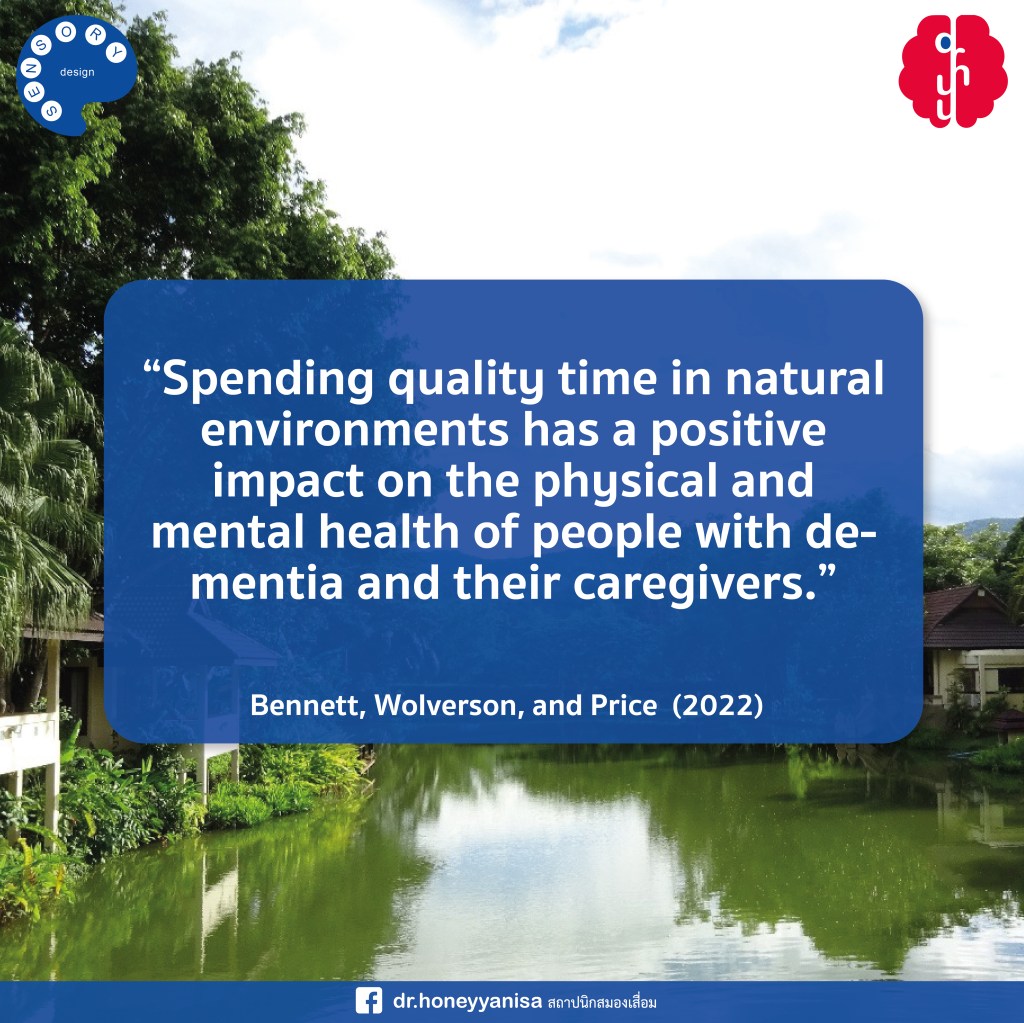
As dementia advances, individuals experience a decline in sensory perception, resulting in a gradual narrowing of their perceived world (Morris, 2010). With diminishing cognitive abilities, individuals with dementia can still perceive their surroundings but struggle to integrate sensory signals to comprehend the context (Hugo and Ganguli, 2014). The natural environment holds a profound influence on their emotional well-being and serves as a means to combat feelings of social isolation. The sense of touch plays a crucial role in nonverbal communication and is closely connected to embodied experiences (Pallasmaa, 2017).
.
ประโยชน์ของสิ่งแวดล้อมธรรมชาติในการดูแลภาวะสมองเสื่อม
.
เมื่อภาวะสมองเสื่อมก้าวหน้าขึ้น บุคคลจะประสบกับการรับรู้ทางประสาทสัมผัสที่ลดลง ส่งผลให้การรับรู้โลกแคบลงทีละน้อย (Morris, 2010) ด้วยความสามารถในการรับรู้ที่ลดลง บุคคลที่มีภาวะสมองเสื่อมยังคงสามารถรับรู้สิ่งรอบตัวได้ แต่มีปัญหาในการรวมสัญญาณทางประสาทสัมผัสเพื่อทำความเข้าใจบริบท (Hugo and Ganguli, 2014) สภาพแวดล้อมทางธรรมชาติมีอิทธิพลอย่างมากต่อความเป็นอยู่ที่ดีทางอารมณ์ของพวกเขา และทำหน้าที่เป็นเครื่องมือในการต่อสู้กับความรู้สึกโดดเดี่ยวทางสังคม ความรู้สึกสัมผัสมีบทบาทสำคัญในการสื่อสารแบบอวัจนภาษาและเชื่อมโยงอย่างใกล้ชิดกับประสบการณ์ที่เป็นตัวเป็นตน (Pallasmaa, 2017)


 Dr.honeyyanisa (DEMENTIA/DISABILITY/DESIGN)