
The term dementia may not be familiar to everyone, but when we mention Alzheimer’s Disease, it’s a name that resonates with many. It tends to evoke varying levels of concern as we delve into the concept of dementia, which encompasses the symptoms of reduced brain activity and memory loss.
Dementia manifests uniquely in each individual as a form of neurodegeneration, wherein the occurrence and progression of dementia depend on the specific type affecting the person. The underlying causes of dementia are not yet fully understood by medical professionals.
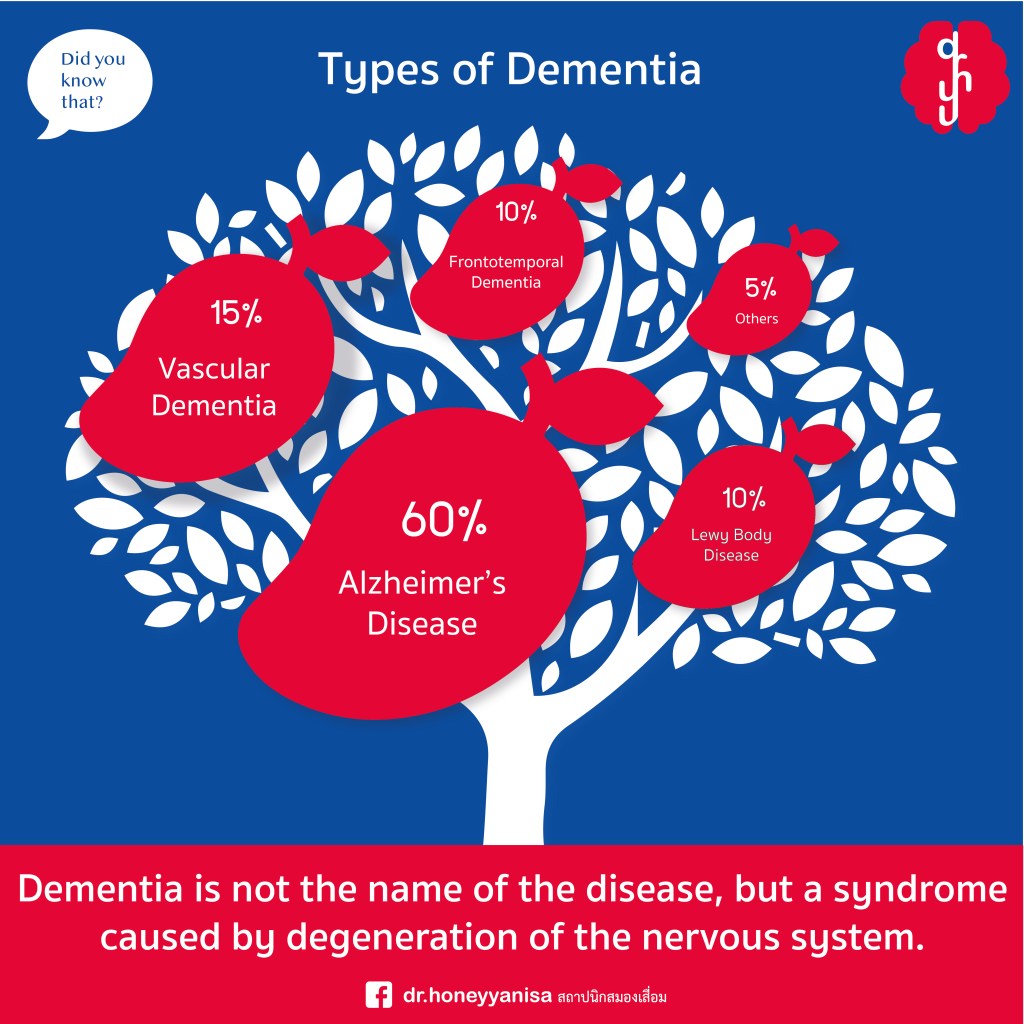
To differentiate between dementia and Alzheimer’s disease, Professor Sirinthorn Chansirikanchan, an expert in the field of neuroscience, provides a simple analogy. Dementia can be likened to a mango, while Alzheimer’s disease is a specific mango variety, such as the cultivar Khieaw Suay. The distinction lies in the different causes of brain disorders. The top four main causes of dementia are as follows:
- Alzheimer’s disease, accounting for 60% of all dementia cases, is characterized by progressive memory loss.
- Vascular dementia, resulting from brain conditions caused by insufficient blood supply, accounts for 15% of all dementia cases.
- Lewy Body Disease, occurring due to the abnormal clustering of Lewy bodies in the brain, accounts for 10% of all dementia cases.
- Frontotemporal dementia, caused by the degeneration of nerve cells in the frontal or lateral parts of the brain, leading to changes in brain connectivity, accounts for 5% of all dementia cases.
Please note that apart from the four main causes mentioned above, there are other factors contributing to dementia, such as Parkinson’s disease, caused by the deterioration of neurotransmitters like dopamine, or Huntington’s disease, which is hereditary and affects movement, among others.
.
ภาวะสมองเสื่อมประเภทต่างๆ
คำว่า ดีเมนเชีย (dementia) หรือ ภาวะสมองเสื่อม อาจจะไม่ใช่คำที่คุ้นเคยของใครหลายๆคน แต่ถ้าเราพูดถึงโรคอัลไซเมอร์ (Alzheimer’s Disease) น่าจะเป็นชื่อโรคที่พวกเราคุ้นเคยกันเป็นอย่างดี และน่าจะสร้างความกังวลไม่มากก็น้อยเมื่อเราพูดถึงชื่อของโรคนี้ ซึ่งจริงๆแล้ว แนวคิดของภาวะสมองเสื่อม หรือ ดีเมนเชีย นั้นเป็นแนวคิดที่รวบรวมเรื่องของอาการของการมีศักยภาพที่ลดลงของสมองและการสูญเสียความทรงจำ
แต่ละคนจะมีประสบการณ์กับภาวะสมองเสื่อมในรูปแบบของตนเองในลักษณะของการเสื่อมของระบบประสาท (neurodegenerative diseases) ซึ่งอัตราการเสื่อมจะขึ้นอยู่กับประเภทของภาวะสมองเสื่อมที่ส่งผลต่อบุคคล ซึ่งทางการแพทย์ยังไม่ทราบสาเหตุหลัก
ในส่วนของความแตกต่างระหว่างภาวะสมองเสื่อมและโรคอัลไซเมอร์ (Alzheimer’s disease) ถ้าให้พูดให้เข้าใจง่ายๆเหมือนที่อาจารย์สิรินทร ฉันศิริกาญจน (อาจารย์หมอผู้เชี่ยวชาญด้านสมอง) ได้อธิบายไว้ก็คือ ดีเมนเชีย (dementia) เปรียบเสมือนมะม่วง และ โรคอัลไซเมอร์ (Alzheimer’s disease) คือสายพันธุ์ของมะม่วง เช่น พันธุ์เขียวเสวย นั่นเอง ประเภทของภาวะสมองเสื่อมนั้น สามารถแบ่งออกด้วยสาเหตุของการเกิดโรคทางสมอง ซึ่งสาเหตุหลักของภาวะสมองเสื่อม 4 อันดับแรก ได้แก่
1.โรคอัลไซเมอร์ (Alzheimer’s Disease) เป็นสาเหตุหลักของภาวะสมองเสื่อม (60% ของผู้มีภาวะสมองเสื่อมทั้งหมด) ซึ่งจะมีอาการสูญเสียความทรงจำแบบค่อยเป็นค่อยไปมากขึ้น ตามลำดับ
2.ภาวะสมองเสื่อมจากโรคหลอดเลือด (Vascular Dementia) มีสาเหตุหลักคือภาวะของสมองที่ขาดเลือดไปหล่อเลี้ยง ทำให้สมองหยุดทำงานอย่างเฉียบพลัน (15% ของผู้มีภาวะสมองเสื่อมทั้งหมด)
3.โรคเลวี บอดี (Lewy Body Disease) มีสาเหตุหลักจากการมีเลวี บอดี (Lewy bodies) ในสมอง ที่จับกันเป็นก้อนมากผิดปกติ (10% ของผู้มีภาวะสมองเสื่อมทั้งหมด)
4.ภาวะสมองเสื่อมบริเวณส่วนหน้า (Frontotemporal Dementia) มีสาเหตุมาจากเซลล์ประสาทที่อยู่บริเวณสมองส่วนหน้าหรือส่วนด้านข้างที่ตาย ทำให้เกิดการเปลี่ยนแปลงของการเชื่อมต่อระหว่างสมองส่วนต่างๆ (5% ของผู้มีภาวะสมองเสื่อมทั้งหมด)
.
ป.ล. นอกเหนือจากสาเหตุหลัก 4 ประการข้างต้นแล้ว ยังมีปัจจัยอื่นๆ ที่ทำให้เกิดภาวะสมองเสื่อม เช่น โรคพาร์กินสัน ซึ่งเกิดจากการเสื่อมสภาพของสารสื่อประสาท เช่น โดปามีน หรือโรคฮันติงตัน ซึ่งเป็นกรรมพันธุ์และส่งผลต่อการเคลื่อนไหว
.
อ้างอิง
- http://www.nia.nih.gov/health/what-is-dementia
- http://www.who.int/news-room/fact-sheets/detail/dementia
- DeTure MA, Dickson DW. The neuropathological diagnosis of Alzheimer’s disease. Mol Neurodegener. 2019 Aug 2;14(1):32. doi: 10.1186/s13024-019-0333-5. PMID: 31375134; PMCID: PMC6679484.

 Dr.honeyyanisa (DEMENTIA/DISABILITY/DESIGN)